


Therapy for South Asian women — for the daughter, wife and mother who has no one to tell
Therapy for South Asian women begins with something most of you have never been given: a place where you are not the one looking after everyone else.
You were raised to be good. Good daughter, good student, good wife, good bahu, good mother. You learned early to read the room, to keep the peace, to swallow the comment, to make sure nobody was upset. You are very skilled at it. And somewhere along the way you stopped knowing what you want, what you feel, or who you would be if nobody was watching. Rubina works with women exactly like you, and she knows this territory from the inside.
- LCSW
- CASAC-2
- Author of Stop Being Okay
- Urdu · Hindi · Punjabi
- In person in NYC
- Online across New York
You might recognise yourself
None of these mean something is wrong with you. They are patterns many desi women share — and patterns can change.
- You feel guilty resting, even when you are exhausted
- Saying no to your mother, mother-in-law or husband makes you feel sick for days
- You are the person everyone calls in an emergency, and nobody asks how you are
- You replay conversations at night, wondering if you said something wrong
- You have achieved a lot, and none of it feels like enough
- You keep your real feelings out of the family WhatsApp group, and out of most rooms
- You worry constantly about what people will say
- You cannot remember the last time you did something only for yourself
If more than two or three of these feel familiar, you are not imagining it, and you are not alone.
Log kya kahenge, and the weight it leaves
Log kya kahenge — what will people say — is a phrase many South Asian women hear before they can even read. It decides which job is acceptable, whom you marry, how you dress, whether you leave a marriage, and whether you ever admit you are struggling. Over time it moves from the aunties into your own head, and it becomes the voice that stops you before you even try.
In therapy, you get to look at that voice clearly. Where it came from. Who it protected. Whether it still serves you. The aim is not to make you stop caring about your family or community. It is to give you back the choice of when their opinion gets the final word.
What we can work on together
- Marriage — feeling unseen, unheard or stuck, whether you want to repair things or are quietly wondering about leaving. Rubina also offers couples therapy for South Asian partners.
- In-laws and joint family life, and how to protect yourself without starting a war
- Being the eldest daughter, and the burnout that comes from a lifetime of responsibility
- People-pleasing and low self-esteem, and learning to want things for yourself
- Motherhood and postpartum changes, including the pressure to be a perfect mother while your own needs disappear
- Anxiety that hides behind competence and constant busyness
- Choices about career, marriage, children or divorce that your family may not agree with
You are allowed to want more
Many women come to Rubina feeling that their unhappiness is selfish. They have a good husband, healthy children, a decent job — what right do they have to complain? That question is part of the conditioning. You can be grateful for your life and still need support. You can love your family and still be drowning.
Rubina doesn't tell women what to do with their marriages or their families. She helps you hear your own voice again, under all the others, so that whatever you choose is actually your choice. For some women, that means staying and changing how they show up. For others, it means bigger decisions. Both are respected here.
Other ways to get support
Individual therapy isn't the only door. Some women find it easier to start somewhere else:
- Log Kya Kahenge group circle →An eight-week online circle for Pakistani and Indian women in America who are done being the strong one.
- Stop Being Okay — Rubina's book →For the woman who has been performing fine for far too long.
- Am I burnt out? A free quiz →Ten questions to help you see where you are right now.
- Therapy for children of immigrants →For first-generation daughters living between two worlds.
What sessions look like
Individual sessions are 50 minutes. Rubina sees women in person in New York City and online across New York State — from your office, your parked car, or a quiet room after the children are asleep. Nobody else needs to know you are going.
You can speak in English, Urdu, Hindi or Punjabi. The first session is a conversation about what brought you here and what you would like to feel differently. There is no pressure to tell everything at once.
Rubina's approach blends self-compassion focused therapy, cognitive behavioral therapy (CBT) and family systems thinking, always grounded in your culture. Fees are listed on the fees and insurance page.
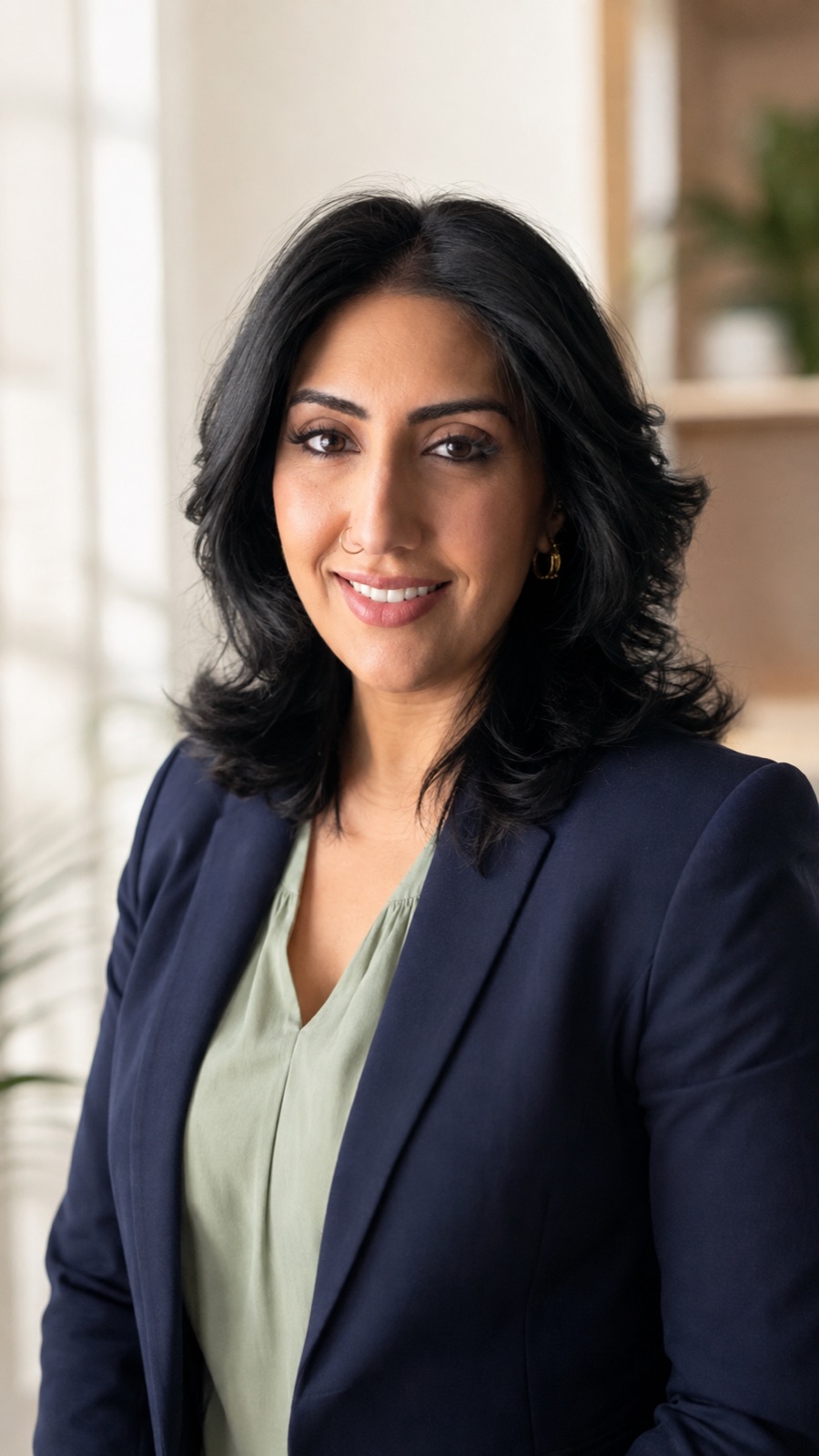
Rubina K. Singh, LCSW, CASAC-2
Rubina has spent more than fifteen years in mental health. She holds a BSW from Rutgers, an MSW from Capella and is completing her doctorate in social work. She is a Licensed Clinical Social Worker in New York, a CASAC Level 2 addiction counselor, and the author of Stop Being Okay. She grew up between cultures, and she speaks English, Urdu, Hindi and Punjabi.
Questions people ask
Will you tell me to leave my marriage or cut off my family?
No. Rubina doesn't make those decisions for anyone. She helps you understand what you feel and what you want, so the choices you make are truly yours — whatever they are.
My husband doesn't know I want therapy. Can I still come?
Yes. Many women begin privately. Sessions are confidential, and online appointments make it easy to attend without explaining where you are going.
Is the group program the same as therapy?
No. Log Kya Kahenge is a therapist-led group program, not individual clinical treatment. Some women do the group, some do individual therapy, and some do both. You can read about the circle here.
Do you only work with Pakistani and Indian women?
No. Rubina works with Bangladeshi, Sri Lankan, Nepali, Indo-Caribbean and other desi women, and with women of every background who recognise these patterns.
What if I start crying and can't stop?
That is completely okay. Many women cry in their first sessions, sometimes after years of holding it in. There is no rush and no judgment.
Last reviewed October 13, 2026 by Rubina K. Singh, LCSW
Reaching out is the whole first step.
You don't need the right words. Leave your name and number, or book a session directly — Rubina's team replies personally, usually within 24 to 48 hours.
Book a session →In a crisis? Call or text 988, or call 911. This site is not an emergency service.