

A Pakistani therapist in NYC and New York State who speaks your language
Finding a Pakistani therapist in NYC often starts quietly — a late-night search on your phone, a tab you close when someone walks into the room, because in your family nobody has ever been to therapy and you are not sure you are allowed to be the first.
Rubina knows that hesitation well. In many Pakistani homes, going to a counselor feels like admitting the family has failed, or like taking private matters outside the house. You might worry about what your parents would say, what your in-laws would think, or whether a therapist would judge your faith, your marriage or your choices. With Rubina, you can bring all of it, including the parts you have never said out loud in Urdu or English.
- LCSW
- CASAC-2
- Author of Stop Being Okay
- Urdu · Hindi · Punjabi
- In person in NYC
- Online across New York
Being the first in your family to try therapy
Most Pakistani clients who reach out are not in crisis. They are functioning. They go to work, look after children, send money home, show up at every dawat and every funeral. What they cannot do anymore is keep pretending it costs them nothing. Being the first person in the family to say "I need help" takes a particular kind of courage, and Rubina treats it that way.
You don't need to tell anyone you have started. You don't need to have a label for what you are feeling. Some people come because they cry in the car after visiting their parents. Some come because they snap at their children and hate themselves afterwards. Some simply feel flat and cannot remember the last time they were happy. Any of those is a reason to begin.
Izzat, privacy and the fear of being found out
In Pakistani culture, family honour — izzat — shapes what can be spoken about and who can know. That is not something to fight against in therapy. It is something to understand. Rubina will never push you to confront your family before you are ready, and she will never treat your loyalty to them as the problem.
What she will do is help you notice where protecting the family's name has quietly become erasing yourself. Where the rule of keeping things inside has meant that nobody, not even you, knows how much you are carrying. Sessions are confidential under New York law, and nothing reaches your family, your community or your mosque. Many clients join from a parked car or a locked office during lunch, and that is completely fine.
What Pakistani clients often bring
Every story is different, but certain themes come up again and again for Pakistani clients in New York:
- Marriage strain — whether the rishta was arranged, semi-arranged or a love marriage the family took years to accept. Couples work is available for both partners together.
- Living with, or near, in-laws, and the exhaustion of always being watched and measured
- Pressure to succeed academically and professionally, and the anxiety that grows underneath that pressure
- Guilt about parents back in Pakistan — not visiting enough, not sending enough, not being there when they got sick
- Grief after losing a parent overseas, sometimes without being able to attend the janaza
- Feeling stuck between the person your family expects and the person you are becoming, which Rubina explores in cultural identity therapy
- Substance use or gambling in the family that everyone knows about and no one names — an area where Rubina's CASAC-2 credential matters. See addiction and recovery support.
When English runs out
Some feelings simply live in Urdu. The way your mother said your name when she was disappointed. The phrase your father used when he meant he was proud but couldn't say it. Rubina speaks Urdu, Hindi, Punjabi and English, so you never have to stop mid-sentence to translate something that loses its meaning in another language.
Many clients start in English and drift into Urdu as the conversation gets closer to the heart of things. Others prefer Punjabi with a parent who joins a family session. Whatever you need is welcome. There is a page with more detail on therapy in Urdu and Hindi.
For Pakistani women, men and families
A large part of Rubina's work is with Pakistani women — daughters, wives and mothers who hold everyone together and have no one to tell when it becomes too much. There is a dedicated page on therapy for South Asian women, and an eight-week online group circle for Pakistani and Indian women called Log Kya Kahenge, built around exactly these pressures.
Pakistani men are welcome too, and so are couples and whole families. Men often arrive later, after years of being told to be strong and provide. Family sessions can help parents and adult children finally talk without the conversation collapsing into the same argument it always does.
Rubina works with clients of every background and faith. You don't need to be Pakistani, or Muslim, to see her — but if you are, you will not have to explain the basics.
What sessions look like
Individual sessions run 50 minutes; couples and family sessions run an hour. Rubina sees clients in person in New York City and online across New York State, so Pakistani families in Queens, Brooklyn, Long Island or upstate can all reach her by secure video.
In the first session you talk, and she listens. She will ask what made you reach out now, what home was like growing up and what you hope might change. There is no right way to answer. You can switch between Urdu and English as often as you like.
Over time, Rubina combines practical tools — such as cognitive behavioral therapy (CBT) for anxious thinking and self-compassion work for the voice that says you are never enough — with a steady, unhurried space to understand your story. Fees and payment details are on the fees page.
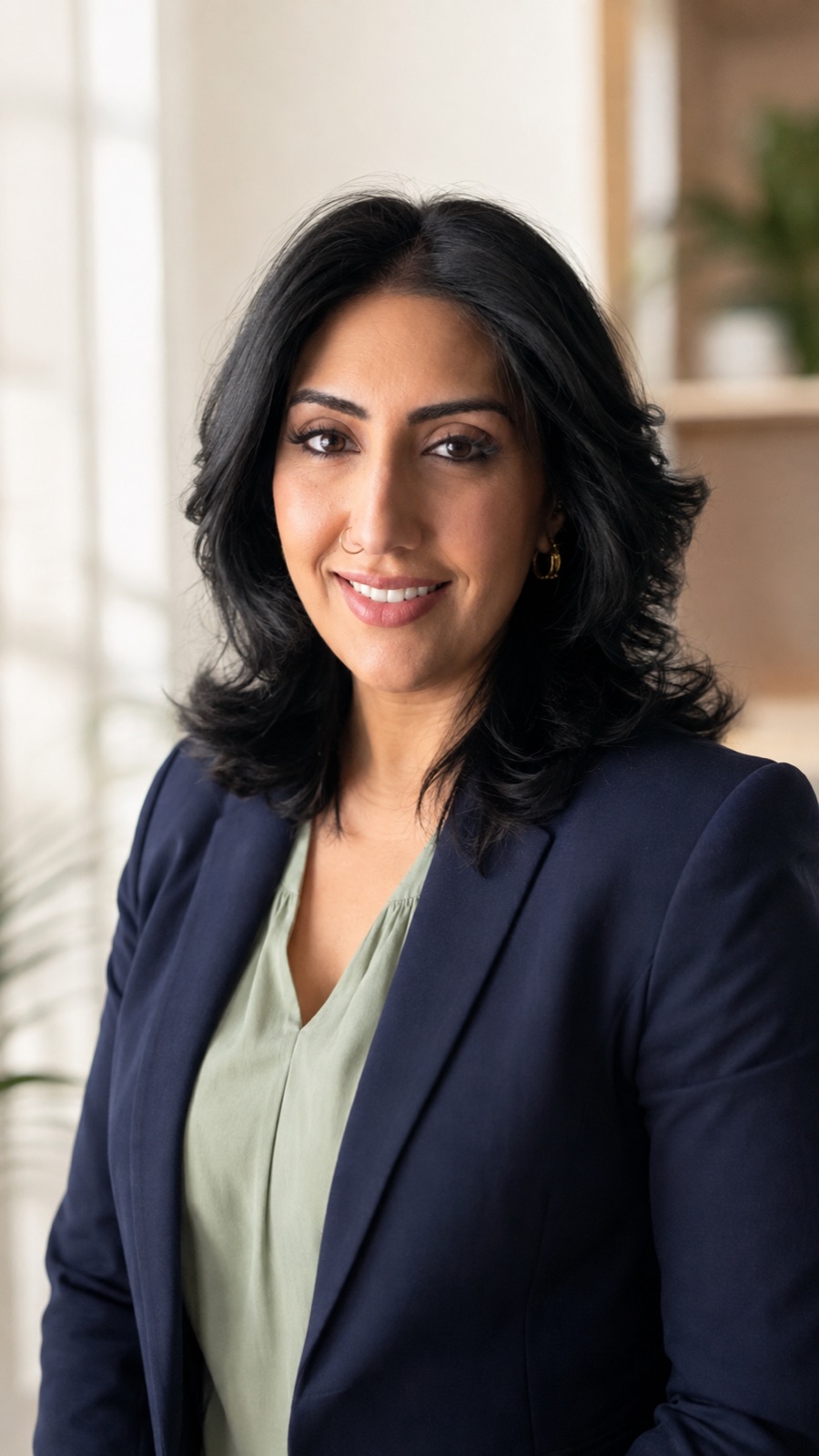
Rubina K. Singh, LCSW, CASAC-2
Rubina has spent more than fifteen years in mental health. She holds a BSW from Rutgers, an MSW from Capella and is completing her doctorate in social work. She is a Licensed Clinical Social Worker in New York, a CASAC Level 2 addiction counselor, and the author of Stop Being Okay. She grew up between cultures, and she speaks English, Urdu, Hindi and Punjabi.
Questions people ask
Will you understand if I don't want my family to know?
Yes. Keeping therapy private is very common, and Rubina will never contact your family without your written permission. Appointment reminders and payments can be arranged discreetly. The only limits to confidentiality are the legal safety exceptions every therapist must follow.
Can we speak in Urdu?
Yes. Sessions can be in Urdu, English, Punjabi or Hindi, or any mix of them. Switching languages mid-sentence is normal and welcome.
I'm Muslim — will my faith be respected?
Yes. Your faith is treated as part of who you are, not as something to be analysed away. Rubina works with clients of all faiths and of none, and religion comes into sessions only as much as you want it to. There is more on the Muslim therapist page.
My husband or parents don't believe in therapy. Can I still come?
Yes. You can begin on your own. Many clients start individually and only later, if ever, invite a partner or parent to join. Learning how to talk with family who don't believe in therapy is often part of the work itself.
Do I have to live in New York City?
No. Rubina is licensed in New York, so anyone living in New York State can see her online. In-person sessions are in New York City.
Last reviewed October 13, 2026 by Rubina K. Singh, LCSW
Reaching out is the whole first step.
You don't need the right words. Leave your name and number, or book a session directly — Rubina's team replies personally, usually within 24 to 48 hours.
Book a session →In a crisis? Call or text 988, or call 911. This site is not an emergency service.