


Therapy for children of immigrants: first-gen, in-between and exhausted
Therapy for children of immigrants starts with naming something you have probably felt your whole life: you were raised to carry your parents' dream, and nobody asked whether you had room for your own.
Maybe you translated letters from the electricity company at age nine. Maybe you were the one who filled out the forms, spoke to the doctor, explained the parent-teacher conference. Maybe your parents worked double shifts so you could have opportunities they never had, and you have been trying to repay that debt ever since. Rubina grew up between cultures herself, and she works with many first-generation adults who are successful on paper and quietly exhausted underneath.
- LCSW
- CASAC-2
- Author of Stop Being Okay
- Urdu · Hindi · Punjabi
- In person in NYC
- Online across New York
You might recognise yourself
These are experiences many first-generation adults describe. They are not flaws. They are the marks of growing up with a lot of responsibility.
- You feel like a different person at home than you are at work or with friends
- You were the family translator, form-filler or fixer from a young age
- Any success feels like it belongs to your parents' sacrifice, not to you
- Choosing what you want feels like ingratitude
- You struggle to explain your family to friends — and your friends to your family
- As the eldest daughter or son, you are still the one everyone leans on
- You find it hard to rest without feeling you are falling behind
- You love your parents deeply and still feel like they have never really seen you
Recognising yourself here is not a diagnosis. It is a starting point for understanding why things feel the way they do.
Living in the in-between
Children of immigrants often describe feeling not fully at home anywhere. Too American for the relatives back home, too traditional for colleagues and friends here. You may switch languages, names, clothing and even personalities depending on the room. That flexibility is a real skill, and it is also tiring.
In therapy, you get a place where you don't have to split yourself. You can talk about Eid and Thanksgiving, about your mother's cooking and your therapist's homework, about your father's silence and your own ambitions, all in the same breath. Rubina understands both worlds, so neither half of you needs to be explained away. If language is part of the split, you can also read about therapy in Urdu and Hindi.
The eldest daughter, and the weight of being dependable
Eldest daughters in immigrant families often become a second parent before they are even teenagers. They look after younger siblings, mediate arguments, absorb a parent's stress and learn that their own needs come last. As adults, they keep doing it, and they rarely notice how much it costs until their body or their relationships start to break down.
Rubina works with many eldest daughters who are tired of being the strong one. Together you look at where that role came from, which parts of it you want to keep, and how to put some of the weight down without abandoning the people you love. Women who want company in this work might look at the Log Kya Kahenge group, built for exactly this experience.
What first-generation clients often work on
- Guilt — about moving out, about career choices, about not calling enough
- Anxiety and perfectionism rooted in the fear of wasting your parents' sacrifice
- Relationships and marriage with a partner from a different culture — see intercultural couples therapy
- Boundaries with parents, without cutting them off
- Cultural identity — deciding which traditions you keep and which you let go
- Childhood experiences that were never called hard, but were
- Burnout from years of high achievement and constant responsibility
Honouring your parents without losing yourself
Most first-generation clients don't want to blame their parents. They understand the sacrifices, the hardships of migration, the loneliness of building a life in a new country. That understanding is real, and it is worth keeping. It just doesn't have to mean ignoring your own pain.
Therapy can hold both truths: your parents did their best, and some of what they did still hurt. When you stop having to choose between those two, many people find they can actually feel closer to their families. Rubina welcomes children of immigrants from every background — South Asian, Caribbean, Latin American, African, East Asian, Middle Eastern and more. You might also find her book, Stop Being Okay, speaks to the patterns you grew up with.
What sessions look like
Individual sessions run for 50 minutes. Rubina sees clients in person in New York City and online across New York State, which is often easiest for busy first-gen professionals working long hours.
The first session is a gentle start: what is bringing you in, what home was like, and what you would like to be different. There is no need to have it figured out. Sessions can be in English, Urdu, Hindi or Punjabi.
Rubina uses approaches such as cognitive behavioral therapy (CBT), family systems work and self-compassion focused therapy to help you understand old patterns and practise new ones. You can find fees on the fees page.
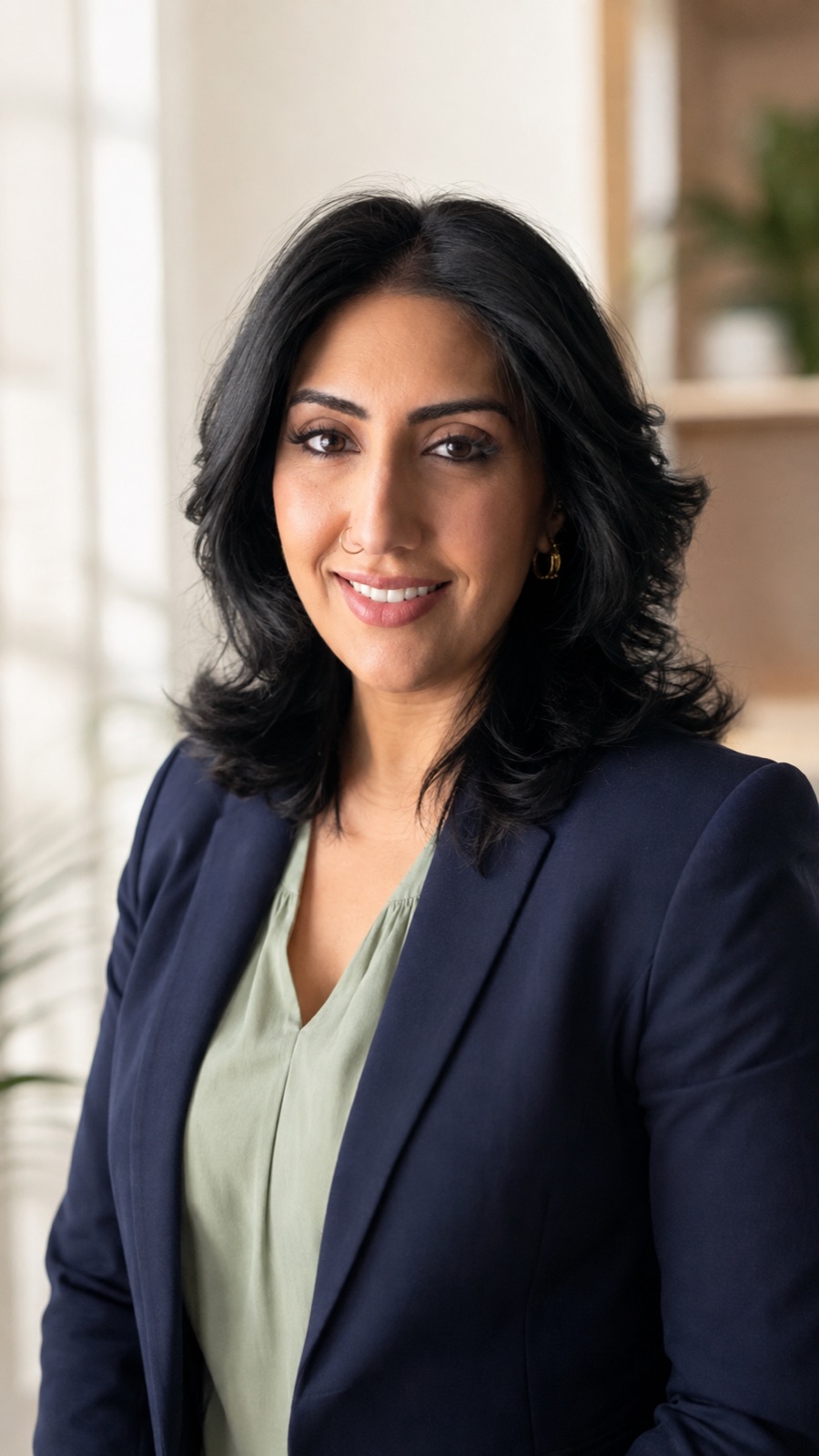
Rubina K. Singh, LCSW, CASAC-2
Rubina has spent more than fifteen years in mental health. She holds a BSW from Rutgers, an MSW from Capella and is completing her doctorate in social work. She is a Licensed Clinical Social Worker in New York, a CASAC Level 2 addiction counselor, and the author of Stop Being Okay. She grew up between cultures, and she speaks English, Urdu, Hindi and Punjabi.
Questions people ask
Do I have to talk badly about my parents in therapy?
No. Many first-generation clients love and respect their parents deeply. Therapy can make room for that love while also making room for the parts that were hard.
I'm not South Asian. Can I still work with Rubina?
Yes. Rubina works with children of immigrants from many backgrounds. The pressures of growing up between cultures are shared far beyond any one community.
Can my parents come to a session with me?
Yes, if and when you want that. Some clients invite a parent later on for a family session. Others prefer to keep therapy entirely private.
Is this only for women?
No. Rubina works with first-generation men too, including eldest sons who carry similar expectations. The checklist above uses common experiences, but anyone is welcome.
How long does therapy usually take?
It varies. Some people come for a few months to work on one specific issue; others stay longer to work on deeper patterns. You and Rubina review progress together and decide what makes sense.
Last reviewed October 13, 2026 by Rubina K. Singh, LCSW
Reaching out is the whole first step.
You don't need the right words. Leave your name and number, or book a session directly — Rubina's team replies personally, usually within 24 to 48 hours.
Book a session →In a crisis? Call or text 988, or call 911. This site is not an emergency service.