

Intercultural couples therapy in NYC for interfaith and mixed families
Intercultural couples therapy in NYC is for partners who love each other across a line their families, their faiths or their histories drew long before they met.
Perhaps you are Hindu and your partner is Muslim. Perhaps one of you grew up in Lahore and the other in Long Island. Perhaps you are a Sikh woman married to a white American man, and the holidays have become a negotiation nobody wins. When you first fell in love, the differences felt interesting. Now they show up in the questions that matter most: how you will raise your children, whose holidays come first, what happens at a funeral, which language the grandchildren will speak. Rubina helps couples hold both worlds without one partner disappearing into the other's.
- LCSW
- CASAC-2
- Author of Stop Being Okay
- Urdu · Hindi · Punjabi
- In person in NYC
- Online across New York
What intercultural and interfaith couples fight about
The arguments look like they are about logistics. Underneath, they are usually about belonging, loyalty and loss:
- Religion and practice — whether to observe, how strictly, and whether one partner is expected to convert
- Children: their names, their faith, their schooling, their language
- Holidays and rituals, and which family gets which day
- Food, alcohol, modesty and the many small rules one partner grew up with and the other did not
- Families who refused, tolerated or are still grieving the match
- Communication styles — one family that shouts and makes up, another that never raises its voice
- Gender roles and who is expected to give up more
- Death and grief rituals, which often surface the deepest differences of all
Neither culture is the problem
A common trap for mixed couples is to make one culture the "normal" one and the other the "difficult" one. That rarely ends well. The partner whose background is treated as the obstacle starts to feel erased, and the partner whose background is treated as the default never learns what the other is losing.
Rubina grew up between cultures herself, and she treats both of your traditions with respect. In sessions you each get to explain what your culture or faith means to you — not what it means to your parents, but to you — and what you are afraid of losing. From there, the work is building a third way of living that belongs to both of you. That might include rituals from both sides, new traditions of your own, or honest agreements about what each of you will and will not compromise.
When families have not accepted you
Some intercultural couples carry years of family disapproval: a father who refused to attend the wedding, a mother who still calls the daughter-in-law by the wrong name, relatives who ask, every visit, when the conversion will happen. That pressure lands on the marriage. One partner may defend the family out of habit; the other may feel abandoned.
Couples therapy helps you face family pressure as a team. Rubina also understands how heavy these questions are in South Asian, Muslim and immigrant families specifically, and for desi couples there is more on South Asian couples therapy. If the hardest part is your own feelings about your identity, cultural identity therapy on your own can sit alongside the couples work.
What if my partner won't come?
If your partner is not ready, individual therapy can still help you work out what you need from the relationship and how to say it without it turning into a fight about whose family is right.
Raising children between two traditions
Children often bring intercultural differences to the surface, even for couples who got along easily for years. Suddenly there are questions about names, circumcision, baptism, mundan ceremonies, Sunday school or weekend Quran classes, which grandparents babysit and which language is spoken at bedtime. Each decision can feel like a vote for one family over the other.
In sessions Rubina helps you separate what each of you truly wants your children to inherit from what you feel you owe your parents. Many couples discover more common ground than they expected: they both want their children to feel proud of where they come from, to have a moral compass and to stay close to their grandparents. Starting from that shared ground makes the specific decisions easier.
Planning an interfaith wedding
The best time to talk about religion, children and families is before the ceremony. Premarital counseling gives engaged interfaith and intercultural couples a calm place to make the decisions that families will otherwise make for them.
What sessions look like
Each couples session is an hour long. You can see Rubina in person in New York City or meet online from anywhere in New York State. She speaks English, Urdu, Hindi and Punjabi, which can help when a partner's parents or a cultural concept does not translate neatly.
Early sessions focus on understanding: each of you explains your background, your family and what your faith or culture asks of you. Later sessions move into agreements and practice. Rubina draws on emotionally focused couples therapy and family systems thinking, and she does not push either partner toward or away from religion.
Sessions are $200 each, private pay. See the fees page for more.
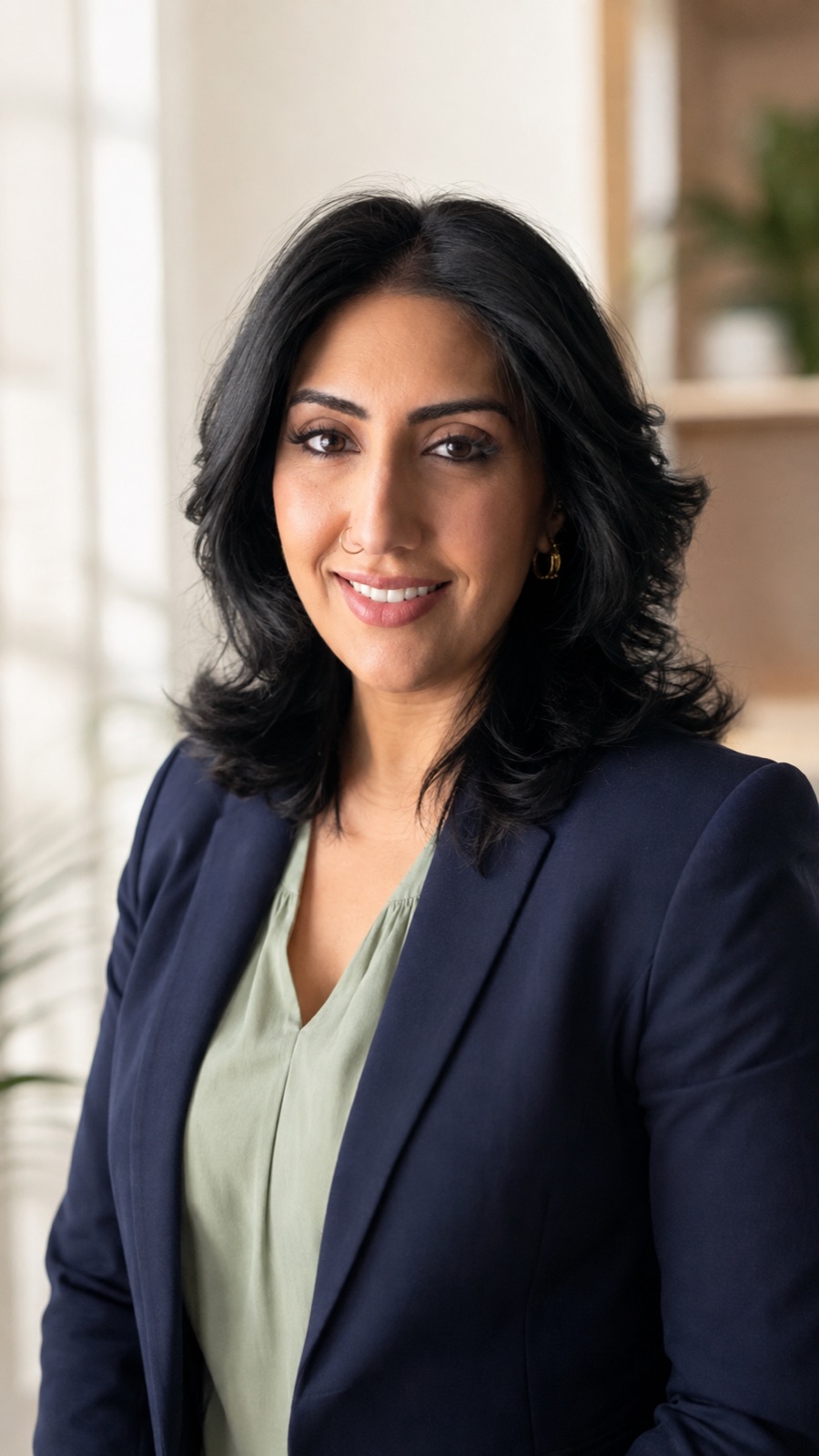
Rubina K. Singh, LCSW, CASAC-2
Rubina has spent more than fifteen years in mental health. She holds a BSW from Rutgers, an MSW from Capella and is completing her doctorate in social work. She is a Licensed Clinical Social Worker in New York, a CASAC Level 2 addiction counselor, and the author of Stop Being Okay. She grew up between cultures, and she speaks English, Urdu, Hindi and Punjabi.
Questions people ask
Will you encourage one of us to convert?
No. Conversion is a decision for the two of you. Rubina will help you talk about it honestly, including what each of you fears, but she has no agenda about the outcome.
We are a Hindu and Muslim couple. Is that something you have experience with?
Yes. Rubina understands the history and family dynamics around Hindu–Muslim, Sikh–Hindu and other cross-community marriages in South Asian families, as well as marriages between South Asians and partners from other backgrounds.
How do we decide what religion to raise our children in?
There is no single answer. Some couples choose one faith, some share both, some choose neither. Therapy helps you understand what matters most to each of you, so the decision feels shared rather than lost.
My partner's family won't accept me. Can therapy help with that?
Therapy cannot change his or her parents, but it can help the two of you respond together, set limits that protect your marriage and grieve what you hoped the family would be.
Do you work with interracial and same-sex couples too?
Yes. Couples of every background and every relationship shape are welcome.
Last reviewed October 13, 2026 by Rubina K. Singh, LCSW
Reaching out is the whole first step.
You don't need the right words. Leave your name and number, or book a session directly — Rubina's team replies personally, usually within 24 to 48 hours.
Book a session →In a crisis? Call or text 988, or call 911. This site is not an emergency service.