
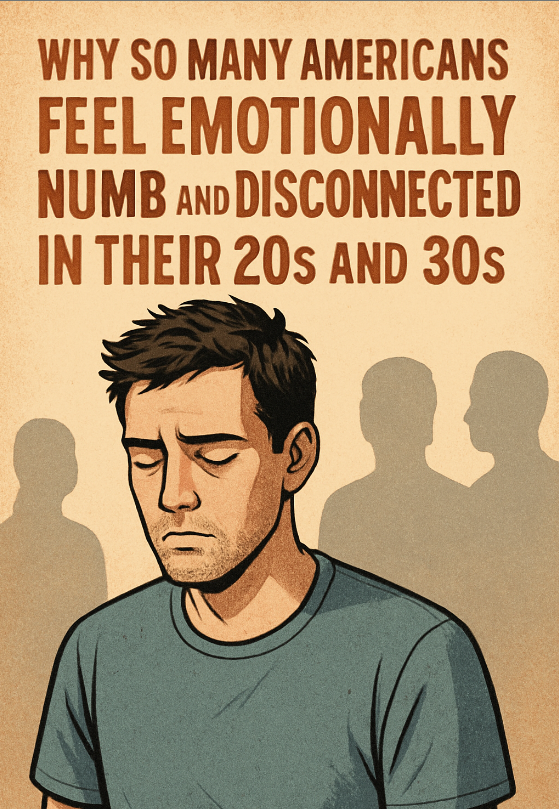
A lot of people in their 20s and 30s in the United States say the same thing:
They don't feel anything. They aren't sad. They aren't happy. They're just empty.
This isn't a dramatic statement. It's happening on a massive scale. And it's not because this generation is "weak" or "too online." It's because emotional numbness is a survival strategy that people learned over years of stress, pressure, and emotional overload.
Let's break down exactly why this is happening and why so many young adults feel disconnected from themselves and everyone around them.
People in their 20s and 30s spent their entire childhood and teenage years watching the world fall apart around them.
They lived through:
When chaos becomes the background noise of life, your brain learns to shut down emotions just to cope. Emotional numbness is not random. It's a response to too much for too long.
This generation works more and rests less. They start burning out in their early 20s.
Reasons are simple:
Insight: When your nervous system never gets a break, it stops reacting. That's why so many people feel like they're on autopilot. They aren't lazy. They're exhausted at a level their parents never experienced at this age.
The phone became the number one coping tool.
Phones make emotions easier to avoid. The problem is avoided emotions don't disappear. They just stop showing up on the surface. That looks like numbness.
Many Americans grew up in homes where:
This is not abuse. It's emotional neglect. And it shows up in adulthood as:
You can't be emotionally present today if you were trained to ignore emotions growing up.
People want connection but they don't trust it.
Many were raised on unstable relationships, divorced parents, conflict at home, or emotionally absent caregivers. So now they avoid closeness because closeness feels dangerous.
Emotional numbness is often self protection.
More young Americans are going to therapy than any generation before, but many still feel numb. Why?
Because therapy can't replace real connection.
Healing requires relationships, community, and safe people.
Most people spend one hour a week in therapy and the other 167 hours feeling:
No therapist can fix that alone. People need human connection outside therapy. And many don't have it.
After the pandemic, many people never fully returned to real social life. They work from home, live online, and avoid meeting people. Human beings need interaction to stay emotionally healthy. Without it, emotions flatten.
The result is simple: Low connection leads to low feeling. Low feeling turns into numbness.
Most jobs want you to:
People get praised for being "unbothered" and "emotionally controlled." Over time, they disconnect not only at work but also in their personal life. The skill becomes a habit.
This emotional shutdown shows up in many ways:
A lot of young adults think something is wrong with them. In reality, they're living in a system that pushes them toward emotional disconnection.
No dramatic solutions. Just practical steps:
Remember: Most people don't need to be "fixed." They need to live in a healthier emotional environment.
Whether you're looking to strengthen an already healthy relationship or address specific challenges, couples therapy can provide valuable tools for growth and connection. Contact us to learn more about our couples counseling and relationship therapy services.
If this article resonated with you, share it with others who might benefit from these insights.